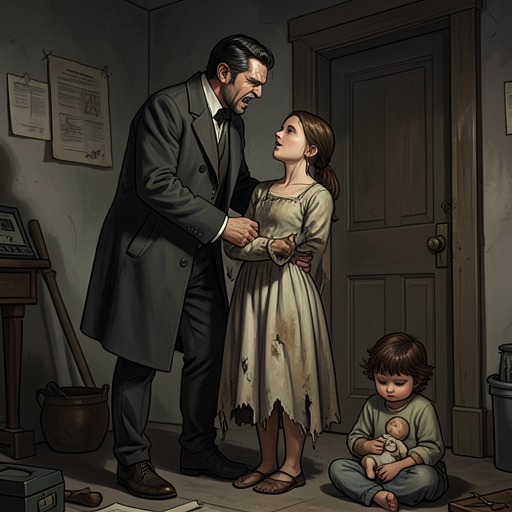
Lavinia’s abusive marriage
Mothering SundayLavinia Huntley’s marriage to Ashley Huntley is an abusive and increasingly estranged relationship organized around his authority and desire for a male heir. Ashley treats his wife’s pregnancies as a means to secure succession and inheritance, while Lavinia bears the physical and emotional costs. When his conduct precipitates her fall and the premature birth of their son, his jubilation over having an heir contrasts sharply with his disregard for the injured Lavinia and the vulnerable baby. The marriage continues, but Lavinia’s understanding of Ashley changes: she stops idealizing him and begins to imagine a life kept apart from him within the same household.
A marriage governed by an heir
The imbalance in the marriage is visible in Ashley’s response to the birth of their first child. The newborn is a girl, and Ashley reacts with rage rather than welcome. He orders Zillah to get rid of the child, threatens consequences if the birth is disclosed, and says he will have a grave prepared. His response makes the child’s sex a matter of dynastic value and places Lavinia and the baby under the power of his decisions. The episode also establishes a pattern that will recur: Ashley’s interest in his family is conditional on what its members can provide for him.
Years later, while Lavinia is pregnant again, Ashley’s uncle’s attorney, Jeremiah Wilde, humiliates her at dinner by pointing out that she has not yet produced a living child. Lavinia answers that women in their forties can give birth, but she restrains herself from confronting Wilde further because she knows Ashley does not want the attorney offended. Ashley, by contrast, joins the pressure on her to produce a healthy son. His strained cheerfulness does not protect her from Wilde’s insult; it confirms that he, too, measures the pregnancy by its chance of producing a male heir.
After Wilde has left the table, Ashley adopts a solicitous manner, urging Lavinia to rest while he stays behind to drink with the attorney. The attention is false in her eyes: she recognizes the gap between his endearments and his actual regard for her. This moment anticipates the larger contradiction in the marriage. Ashley speaks as though he is caring for a mother-to-be, yet his priorities remain his own standing, pleasure, and inheritance.
Control and the fall
Ashley’s authority becomes overtly threatening after Lavinia attends the funeral of a young maid who had been mistreated. When Lavinia returns, he is drinking and angry that she went out while pregnant, especially to the funeral. She maintains that she had the right to pay her respects. He answers by comparing her willingness to attend the funeral with her reluctance to entertain his guests, then insists that he is master of the house. When she says she needs to rest and tries to leave, he blocks her and demands that she obtain his permission before going upstairs.
Lavinia continues up the stairs rather than obeying him. Ashley follows, shouts at her to return, and catches her arm when she is close to the top. He swings her around; she loses her footing and falls. The account presents the fall as the consequence of this violent confrontation, not as a planned attempt to injure her. The maids come running, and Lavinia is left unconscious and badly hurt. Her pregnancy turns the incident into a crisis for both mother and child: the birth comes too early, and the household fears that neither will survive.
The aftermath exposes the distance between Ashley’s dynastic hopes and his care for the people involved. Zillah helps tend Lavinia and the tiny newborn while the doctor warns that the boy may not live. Ashley enters, ignores his injured wife and the emergency around her, and asks what has happened. Once told that he has a son, he celebrates the birth and immediately wants the attorney informed. Zillah tells him that the baby’s premature arrival follows from what he did and warns that money cannot guarantee either his wife’s or his child’s survival. Ashley’s response is to insist that the child must live and to offer money for a nurse, linking his excitement to both the heir and the wealth he expects to enjoy.
Estrangement after Stephen’s birth
Stephen Huntley survives, but he remains fragile and needs frequent, careful feeding. Molly Worthington helps sustain him, while Zillah continues to look after Lavinia as she recovers from her injuries. The contrast in their care is telling: Lavinia is devoted to her baby, and the household makes room for his needs, whereas Ashley soon spends little time at home. After receiving an advance on his uncle’s money, he goes away and squanders his new wealth. His absence follows the pattern already suggested by his response to the birth: he wants the status and advantage of a son more than the daily work of caring for one.
Lavinia tells Zillah that Ashley is visiting friends in London and says that having Stephen was, for him, only a means to an end. She no longer describes him with the admiration she once felt. Instead, she sees him as selfish and concerned chiefly with himself. Her changed view is more than disappointment at his absence; it is a recognition that his authority and declarations of concern have not amounted to tenderness or dependable care.
She also begins to imagine practical distance. Now that Ashley has a son, she hopes he will sleep in his own room and leave her alone. Zillah regrets that Lavinia remains in a loveless marriage, but recognizes that the baby has brought her mistress a measure of happiness. Lavinia talks about a future in which she will buy Stephen a pony, arrange for George to teach him to ride, employ a home tutor, and take him to church and on summer picnics. These plans reveal the emotional life she is building around her child, in contrast to the inheritance-driven hopes Ashley attached to his birth.
A continuing estrangement
The pattern persists beyond the first months of Stephen’s life. Ashley is often away attending race meetings, his passion for horses taking him around the country. Lavinia is grieved that he barely looks at their son even when he is home, but she takes comfort in the affection Stephen receives from the rest of the household. The marriage is not shown ending; rather, it settles into separation and emotional distance, with Lavinia wishing to keep Ashley apart from her as much as circumstances allow.
The relationship’s significance lies in the disparity between marriage as Ashley exercises it and family as Lavinia tries to make it. He invokes his position as master and expects a male heir, but offers neither protection nor sustained care. Lavinia’s movement from restrained accommodation to clear-eyed estrangement marks a change in her understanding, even though the evidence does not show her escaping the marriage. Stephen’s birth gives her a cherished child, yet it does not repair the bond between husband and wife: Ashley’s triumph at having a son is followed by neglect, while Lavinia’s hopes turn toward a loving life with the boy independent of her husband’s attention.